
Dentium Successfully Hosts “All In One Seminar,” Integrating the Year’s Key Clinical Topics
On December 13, Dentium successfully held the “All In One Seminar,” a comprehensive clinical event designed to integrate the most significant topics that shaped dental practice throughout the year. Moving beyond individual technologies or product introductions, the seminar focused on a holistic view of implant treatment, encompassing diagnosis, treatment planning, surgery, prosthetics, and peri-implant soft tissue management within a single, coherent clinical flow.
Covering a wide range of topics—including AI and intraoral scanning (IOS), CT-based occlusal analysis, principles of sinus augmentation, and peri-implant soft tissue management—each lecture addressed a distinct area while sharing a common objective: making clinical practice simpler and more precise. The seminar consolidated Dentium’s accumulated clinical experience and technological insights from 2025, offering clear guidance on what clinicians should select and how they should apply these tools in an evolving clinical environment.
AI, IOS, and CT: Redefining Digital Dentistry in Daily Practice
The opening lecture was delivered by Dr. Ha-Young Kim (Uridul Prosthodontic Dental Clinic), who explored how AI and IOS are transforming dental practice from a clinician’s perspective. Beginning with the fundamental principles of AI, Dr. Kim systematically explained how AI technologies are being applied in dentistry, effectively lowering the entry barrier to digital workflows.
In the IOS segment, she examined how intraoral scanners acquire data and introduced the Shining 3D Elite scanner, highlighting its ability to automatically filter unnecessary soft tissue—such as movable mucosa—using AI, thereby significantly improving scan accuracy.
In the CT segment, Dentium’s Dentium 3D Viewer was a focal point. Its AI Implant Planning function, which automatically recognizes missing teeth and proposes fixture and crown positions, demonstrated clear clinical applicability. In addition, AI Segmentation, which automatically visualizes teeth, maxillary sinuses, airways, and maxillomandibular structures, was highlighted as a powerful tool for enhancing patient communication. Dr. Kim also noted the rapid expansion of AI-based design functions, such as AI Crown Design, presenting a clear picture of digital dentistry as an ongoing, evolving process.
CT-Based Occlusal Analysis: A New Standard for Predictable Prosthodontics
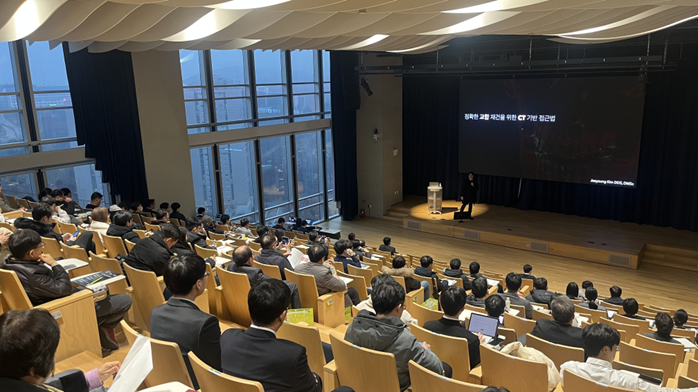
Prof. Jae-Young Kim (Department of Prosthodontics, Yonsei University Dental Hospital) followed with a lecture titled “A CT-Based Approach to Accurate Occlusal Reconstruction.” He revisited the fundamentals of occlusal diagnosis, starting from the practical reality that patients leave the clinic, and emphasized the importance of reliable reference tools clinicians can depend on in their absence. By reviewing the history and limitations of traditional articulators, he illustrated how advancements in digital tools have reshaped occlusal analysis.
Through clinical cases, Prof. Kim demonstrated how utilizing high-precision bright CT data significantly enhances diagnostic and restorative accuracy, surpassing conventional facial scan-based approaches. Particular attention was drawn to the AI Occlusal Plane function in Dentium 3D Viewer, which automatically identifies the midline and ideal occlusal plane based on anatomical landmarks. This capability establishes a clear and reliable reference for prosthetic design.
He emphasized that centric relation (CR), vertical dimension (VD), and occlusal plane (OP) are the most critical elements in prosthodontics. Securing a stable midline and occlusal plane alone can dramatically improve design accuracy and predictability—not only in routine prosthetics, but also in anterior esthetic and full-arch restorations. The lecture underscored how CT has evolved from a diagnostic tool into a core instrument for treatment planning and prosthetic design.
Simplifying Sinus Augmentation Through Clear Principles
Prof. Hyun-Chang Lim (Department of Periodontology, Kyung Hee University Dental Hospital) delivered a lecture titled “Simple Principles, Simple Sinus Augmentation,” in which he distilled sinus lift procedures into clear, practical principles. Moving beyond approaches based solely on residual bone height (RBH), he emphasized the importance of also considering sinus width and soft tissue height, noting that lateral approaches may be more advantageous in cases requiring lesion management.
Clinical cases utilizing Dentium’s DASK Simple system were presented, highlighting the advantages of its small-head, long-length lateral drill, which allows flexible angle control, as well as curettes with various angulations that facilitate membrane elevation. Prof. Lim clearly articulated the principles of forming a small window lateral approach using compact instruments, emphasizing reduced invasiveness. He also noted that collagenated bone substitute materials offer advantages in complication management and handling compared to particulate grafts, providing practical insights for everyday clinical decision-making.
Managing Complications in Sinus Augmentation
Prof. Jung-Woo Nam (Department of Oral and Maxillofacial Surgery, Wonkwang University Sanbon Dental Hospital) focused on complications associated with sinus augmentation and their management through clinical cases. He systematically reviewed common complications and shared key considerations for treatment planning and real-world response strategies.
Particular interest was drawn to the crestal approach using DASK Simple’s compaction drill. The reverse-rotating drill pushes autogenous bone chips from the lateral wall toward the sinus, forming a protective “buffer” that reduces the risk of membrane perforation. This mechanism was presented as a safe and intuitive alternative for simplified sinus augmentation.
Soft Tissue Stability as the Key to Long-Term Implant Success
The final lecture was delivered by Prof. Young-Woo Song (Department of Periodontology, Veterans Health Service Medical Center), who emphasized that peri-implant soft tissue stability is a decisive factor in long-term implant prognosis. He systematically outlined the fundamental principles of soft tissue management and the key clinical decision-making criteria clinicians should consider.
Drawing on the Easy Bone Graft concept, Prof. Song presented integrated strategies for soft tissue and bone regeneration through clinical cases. Using Collagen Graft x1D, he demonstrated predictable and stable outcomes in soft tissue augmentation, providing attendees with practical techniques that can be immediately applied in daily practice.
One Message, One Direction: Making Clinical Practice Simpler and More Precise
The All In One Seminar served as a unifying platform for Dentium’s key clinical messages from 2025. From AI-based diagnosis and planning, to simplified surgical approaches, and soft tissue management that determines treatment outcomes, the diverse lectures ultimately converged on a single direction: making clinical practice easier and more accurate.
Rather than emphasizing technology itself, Dentium clearly demonstrated how technology gains meaning only when seamlessly integrated into the clinician’s real-world workflow.
Looking ahead, Dentium will host the “Easy Bone Graft Forum” on January 10 at its Gwanggyo headquarters, where more in-depth discussions on bone grafting and soft tissue management are expected to continue—already drawing strong anticipation from clinicians.